On the latest episode of America’s Culinary Cup, hosted by Padma Lakshmi, the competition heated up as the contestants faced another challenge that tested their abilities under pressure. The focus of the challenge was consistency, a critical skill for any professional chef. In the kitchen, it’s not enough to create a spectacular dish once in a while; a great chef must produce high-quality food consistently, time and time again. This challenge pushed the remaining contestants to showcase their precision and ability to replicate excellence.

The remaining six chefs were tasked with preparing thirty identical fish dishes. This test wasn’t just about preparing fish, but about mastering the complexity of delivering the same level of quality in every single dish. For many, this would prove to be a daunting task, as fish is notoriously difficult to cook to perfection, requiring specific methods to avoid overcooking or undercooking it. The contestants had to work under the guidance of three different cooking techniques: grilling, poaching, and searing. As the chefs stood ready, they knew that their consistency, technique, and presentation would all be put to the test.
As the challenge unfolded, the chefs were paired in teams of two, with the advantage of team selection going to Buddha Lo, who had won the previous week’s challenge. Buddha, a Michelin-starred chef and a two-time Top Chef winner, picked Matt Peters, a Bocuse D’Or Gold Medalist, as his partner, selecting poaching as their method of preparation. The other two teams were Keith Corbin, a James Beard Award-nominated chef, and Chris Morgan, a Michelin-starred chef, who were tasked with searing their fish. Katie Button, a James Beard Award-winning chef, was paired with Cara Stadler, a James Beard-nominated chef, to grill their fish.
The judges for the evening were Padma Lakshmi, Michael Cimarusti, a renowned seafood chef, and Wylie Dufresne, a celebrated culinary innovator. The three chefs would grade the contestants on four key criteria: taste, creativity, presentation, and their mastery of the consistency commandment. Each judge could award a maximum of 5 points in each category, resulting in a total possible score of 60 points.
As the cooking commenced, the contestants worked furiously to produce dishes that were both consistent and perfectly executed. The teams were under immense pressure to deliver the same quality on all 30 plates, which was no easy feat. Buddha and Matt, who had selected poaching as their cooking method, worked seamlessly together, creating dishes that showcased their skill and experience. They earned a near-perfect score of 57 points out of 60. Katie and Cara, who worked with grilling, struggled with a few of their dishes but still managed to deliver a decent performance, earning 48 points. Keith and Chris, who were tasked with searing, faced the most difficulties throughout the challenge. Despite their best efforts, their dishes were less consistent, and they scored only 35 points, putting them in a vulnerable position for the elimination round.
The elimination challenge was a tense moment for the chefs. It required each of the remaining contestants to make three French omelets, one for each of the judges. The French omelet is a classic culinary dish known for its delicate texture and precision in execution. It is also notoriously difficult to make perfectly every time, especially when the chef must prepare several omelets in a short period, ensuring each one is consistent. In keeping with the challenge’s focus on consistency, the judges would evaluate the omelets to see who could master this simple yet difficult dish.

Padma Lakshmi, Michael Cimarusti, and Wylie Dufresne each tasted the omelets from the four contestants: Keith, Cara, Chris, and Katie. As the judges sampled each dish, they noted the flaws and inconsistencies. Keith’s omelets, unfortunately, did not live up to the judges’ expectations. Padma Lakshmi commented that Keith’s omelet was the least consistent, a sentiment echoed by both Michael Cimarusti and Wylie Dufresne. The three judges all agreed that Keith’s omelets lacked the precision and consistency required at this stage of the competition. Despite his many strengths as a chef, it was clear that consistency was his downfall in this particular challenge.
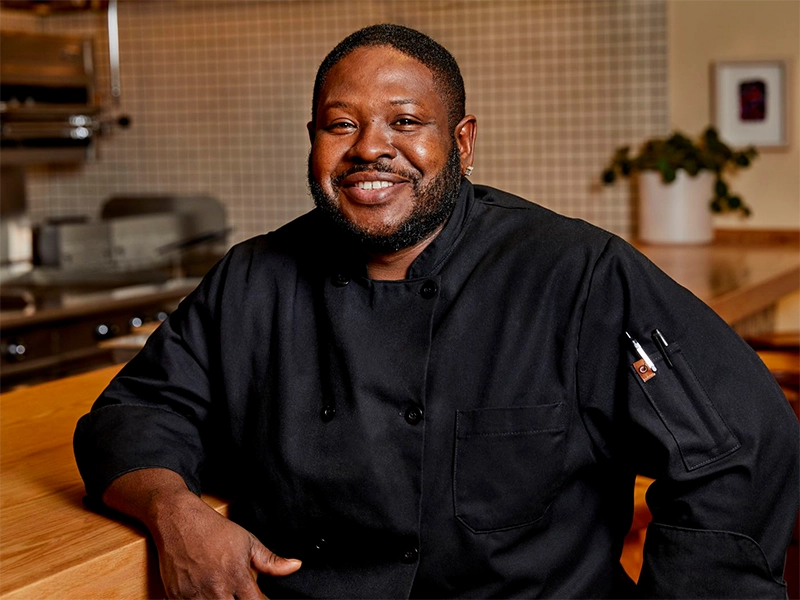
As a result, Keith Corbin was eliminated from the competition. It was a heartbreaking moment for the chef, who had worked tirelessly to stay in the competition. Keith’s journey had not been an easy one. He grew up in Watts, California, facing poverty and gang violence. He didn’t attend culinary school, and his introduction to cooking was rooted in survival. His perseverance and grit had carried him through many challenges, and he had proven his worth in the competition up until this point. However, the consistency challenge was one he could not overcome.
Before leaving, Keith shared a touching sentiment with the other chefs. “One thing I’ve been consistent at was fighting in this competition for my place, and I’m proud of that,” he said. “I am someone who grew up with less than other people. I come from Watts. I overcame the gangs, prison, poverty; I didn’t go to culinary school. My introduction to the kitchen was survival. If I inspire one person where I come from, I’ve won.”
Keith’s elimination was a reminder that in the high-stakes world of America’s Culinary Cup, only the most consistent chefs can thrive. The competition continues with the remaining five chefs, who will need to hone their skills even further as they push toward the ultimate prize: a $1 million cash reward. As the season progresses, the pressure will only intensify, and the remaining chefs will need to prove they can meet the culinary commandments in every challenge that comes their way.