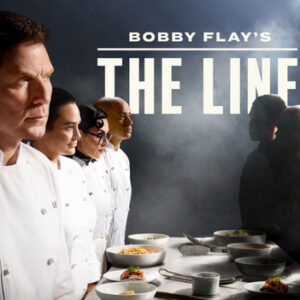
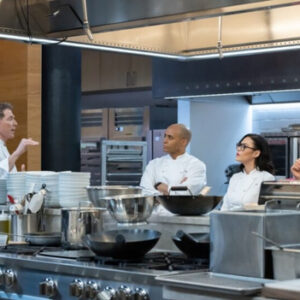
Bobby Flay’s new Food Network series The Line may look like another cooking competition at first glance, but its real test appears to begin only after the cooking starts.
The show is built around a harsher question than the one most culinary competitions ask. It is not simply about whether a chef can make a delicious dish. It is about whether that chef can continue performing when the kitchen becomes crowded, the clock becomes unforgiving, mistakes begin to accumulate, and service has to keep moving anyway.
That distinction is what gives The Line its identity.

According to 360 Headlines, the series premiered on Food Network at 9:00 p.m. ET/PT on September 8, 2026, followed by its streaming release on HBO Max on September 9. From the beginning, the format was designed to recreate the urgency of a professional restaurant kitchen rather than the more controlled conditions of a conventional studio competition.
The professional “line” is the center of the entire concept.
In a restaurant, the line is where preparation turns into service. Ingredients have to be ready, dishes have to be completed at the right moment, and food has to move out with consistency. If one part of that process falls behind, the consequences can spread quickly. The show takes that reality and turns it into the core source of pressure.

Contestants are expected to manage preparation, organization, timing, and execution under strict time constraints. Culinary skill remains essential, but it is no longer enough by itself. A chef may have the technical ability to produce an excellent dish and still perform badly if the plate arrives too late, if an important component is forgotten, or if the entire workflow starts to lose control.
That is where The Line becomes more than a test of creativity.
Many food competitions give chefs time to concentrate on a single challenge, a single dish, or a specific theme. Here, the pressure seems to come from the need to continue operating while multiple things are happening at once. Speed and precision have to coexist. Organization becomes as important as inspiration. A contestant who cooks beautifully but works too slowly can still be vulnerable.
The format also puts a much greater emphasis on recovery.

In a normal challenge, a mistake may affect one plate. In a restaurant-style environment, one mistake can create a chain reaction. A delay can make another task harder. A missing component can force a chef to improvise. A badly timed decision can disrupt the rhythm of the entire service.
That means the real drama is not necessarily the first error. It is what happens afterward.
Can the chef stay calm? Can the contestant adjust quickly? Can someone make a smart decision when there is no time to start again?
Those questions may ultimately matter more than the simple issue of who has the most refined technique.
Bobby Flay’s role adds another layer of pressure. He is not presented merely as a host who introduces challenges and waits for results. His experience, competitive personality, and demanding standards are positioned at the center of the show. Contestants are effectively being asked to prove that they can meet professional expectations while working in conditions designed to expose weaknesses quickly.
That makes every decision feel more consequential.
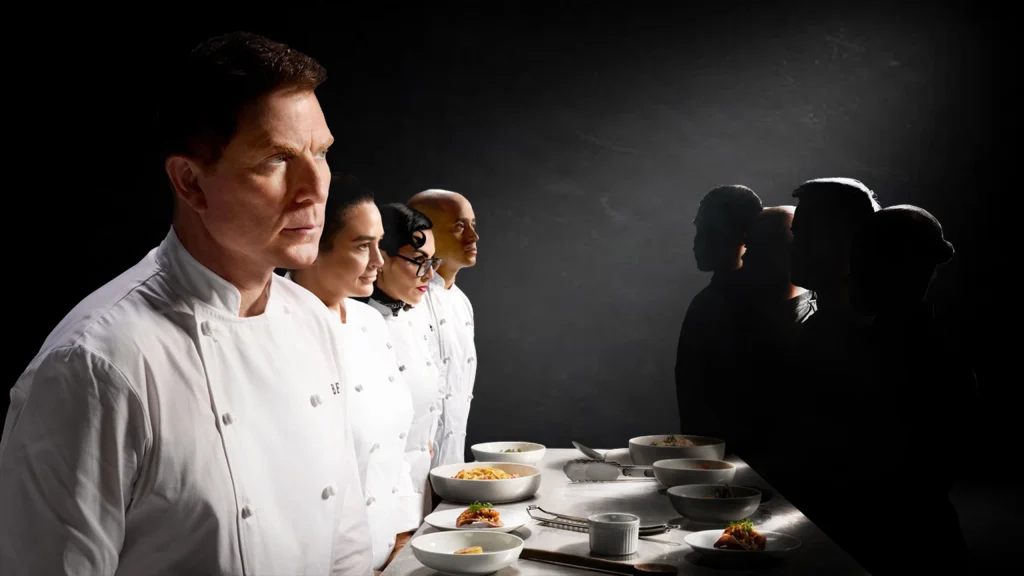
When the person watching is a chef known for decades of high-level culinary competition, a small mistake can become difficult to ignore. A few seconds of hesitation, a poorly organized station, or a late plate can reveal just as much about a contestant as the final taste of the food.
This also explains why The Line can feel more like a survival test than a traditional cooking show.
The central challenge is not simply to impress. It is to endure.
A contestant has to keep moving when the kitchen becomes stressful, when time starts disappearing, and when earlier mistakes make later decisions more difficult. In that sense, the show is testing whether a chef can continue thinking clearly while the environment becomes less forgiving.
That is probably where the format has its strongest potential.
Cooking competitions have already shown viewers countless beautiful plates, creative concepts, and dramatic eliminations. The Line appears to be betting that the next source of tension comes from something more operational: watching a professional system begin to strain and seeing who can stop it from falling apart.
The show’s identity therefore depends heavily on the contrast between talent and control.

A chef can be highly skilled and still lose control of service. Another contestant may not create the flashiest dish but could prove more effective under pressure because of better timing, faster decisions, and stronger organization.
That creates a different definition of success.
The winner is not necessarily just the person who cooks the most impressive food in isolation. The strongest contestant may be the one who can continue producing good food while everything around them becomes harder.
Ultimately, Bobby Flay’s The Line appears to be turning a professional kitchen’s most ordinary reality into its biggest dramatic weapon: nothing stops just because something goes wrong.
Service continues.
And that may be the most important idea behind the entire show. The real challenge begins at the exact moment when a contestant no longer has the luxury of slowing down.