When Chopped Castaways was first announced, the concept sounded like a fresh evolution of Food Network’s long-running cooking competition formula. The series promised to combine culinary creativity with the harsh realities of island survival, placing professional chefs in an environment where they would have to adapt, strategize, and cook under conditions far different from a traditional kitchen.
However, after four episodes, a growing number of viewers are beginning to ask an important question: Is Chopped Castaways still a cooking competition, or is it slowly becoming a reality television hybrid that borrows too heavily from other franchises?
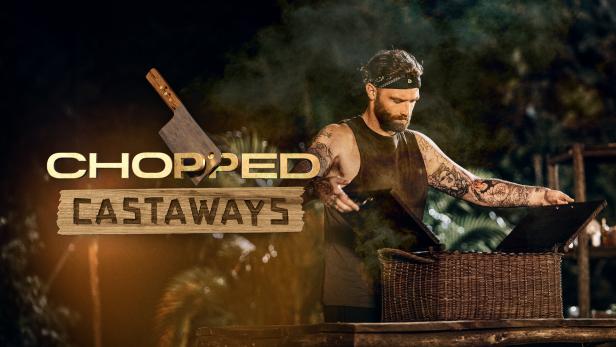
The debate intensified following Episode 4, which introduced two major twists that immediately sparked discussion among fans.
The first challenge required chefs to select their own “weapon” and compete in a target-shooting competition. Contestants who performed well gained access to higher-value ingredients, while those who struggled found themselves at an immediate disadvantage before cooking even began.
While some viewers enjoyed the added layer of strategy, others pointed out that success in the challenge depended on skills completely unrelated to cooking.
Many fans compared the segment to challenges commonly seen on Survivor, where physical performance directly influences a player’s ability to secure resources and advantages.
That comparison has become increasingly common throughout the season.
Episode 1 emphasized gathering ingredients in the wild. Episode 2 focused heavily on resource management. Episode 3 featured the underwater “Dive Deep” challenge. Now Episode 4 has introduced a competitive target-shooting component.
Viewed individually, each challenge can be justified within the show’s island-survival premise. But when combined, some viewers feel the series is gradually shifting its focus away from culinary excellence and toward reality-game mechanics.

As one fan noted online, “Chopped Castaways is starting to feel like Survivor with food.”
The conversation became even more interesting when Episode 4 introduced the show’s first-ever Relay Cook challenge.
According to the official format, teams must work together to create a single unified dish. One chef begins the dish, another takes over midway, and a third chef completes the final execution and presentation.
The concept immediately reminded many viewers of famous team challenges from Top Chef rather than traditional Chopped competitions.
In classic Chopped, contestants are largely judged on their individual ability to transform mystery basket ingredients into successful dishes under intense time pressure.
The Relay Cook changes that dynamic completely.
Now chefs must trust teammates to continue their vision, communicate effectively, and avoid mistakes that could affect the entire team. If one chef makes a critical error, everyone pays the price.
That possibility has generated concern among viewers who worry that stronger chefs could be eliminated because of weaker teammates.
Some fans have already labeled the challenge a potential “Top Chef team challenge nightmare,” referring to the franchise’s history of controversial team eliminations.
The larger criticism emerging online is not necessarily that the individual twists are bad. Rather, some viewers believe the show is struggling to establish a clear identity.
At the moment, Chopped Castaways appears to contain elements from several different reality competition franchises.
It has the mystery ingredients and culinary creativity of Chopped. It includes the survival elements and resource-based advantages associated with Survivor. Meanwhile, challenges like Relay Cook feel heavily inspired by Top Chef.
For some fans, that combination is exciting. For others, it feels unfocused.
The biggest concern is that cooking skill may no longer be the primary factor determining success.
A chef could potentially possess the strongest culinary abilities in the competition yet be disadvantaged by poor performance in a target challenge, a bad team assignment, an unexpected twist, or a teammate’s mistake during a relay.
When that happens, viewers may begin to question whether the competition is still rewarding the best chef.
At the same time, there is another perspective.
Food Network already has several traditional cooking competitions. Viewers can watch Chopped, Tournament of Champions, or Beat Bobby Flay for formats centered almost entirely on cooking performance.
From that standpoint, Chopped Castaways may be intentionally trying to create something different.
Rather than presenting another standard cooking competition, the producers appear to be building what some fans have called “Survivor for chefs”—a game where adaptability, teamwork, strategy, and survival are just as important as technical culinary skill.
Whether that approach ultimately succeeds remains to be seen.
For now, Episode 4 represents a major turning point for the season. The introduction of target-shooting advantages and the Relay Cook challenge has amplified an ongoing debate about the show’s identity.
Is Chopped Castaways a bold reinvention of the cooking competition genre, or is it becoming a reality TV stew made from pieces of other successful shows?
The answer may determine whether the series becomes Food Network’s next breakout franchise—or a fascinating experiment that never fully discovers what it wants to be. As the competition continues and the twists become more aggressive, viewers will be watching closely to see whether cooking remains at the heart of the game or simply becomes one ingredient in a much larger reality television recipe.