For nearly two decades, Padma Lakshmi has helped define how audiences experience culinary competition television. But with America’s Culinary Cup, even she found herself caught off guard. As the creator and host of the CBS series, Lakshmi recently admitted that Season 1 delivered a level of unpredictability she didn’t fully anticipate—even while sitting at the judges’ table.

Speaking ahead of the May 6 release of her Parade cover story and the show’s upcoming finale, Lakshmi revealed that several eliminations genuinely surprised her. Despite tasting every dish and participating in the judging process, she emphasized that the final outcome was never entirely in her control. With multiple judges scoring independently, the results often unfolded in unexpected ways. “There are so many twists and turns,” she explained, noting that she couldn’t always predict how her fellow judges would respond.
One of the most dramatic turning points of the season came midway through the competition, when the remaining eight chefs were asked to evaluate each other. They voted on who they believed was most likely—and least likely—to win the $1 million grand prize, the largest payout ever offered in a culinary competition. The results were emotionally charged. Beverly Kim was named “most likely to win,” a moment that overwhelmed her with emotion, while Chris Morgan was labeled “least likely,” leaving him visibly stunned.
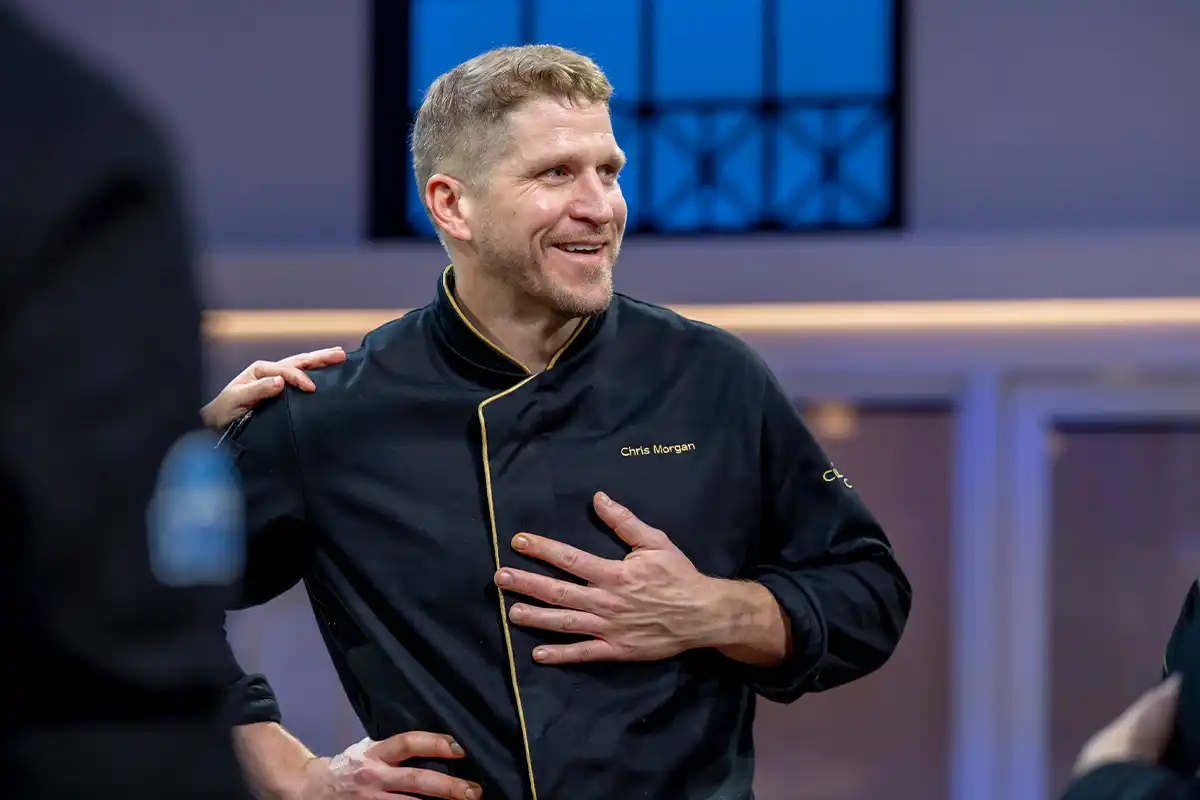
Even Lakshmi found that outcome difficult to reconcile. Having tasted Morgan’s food firsthand, she admitted she was surprised that his peers viewed him as the weakest contender. Yet what followed was even more shocking. Just one episode later, Beverly Kim—fresh off being voted the frontrunner—was eliminated from the competition.
Her exit came during the Culinary Science and Technology challenge, a highly technical round rooted in molecular gastronomy. Despite her strong track record, including earlier dominance in challenges like the Sustainability commandment, Kim faltered in a format that demanded a different kind of precision. The challenge leaned into the expertise of co-judge Wylie Dufresne, and ultimately exposed the narrow margin for error at this level. Lakshmi described Kim’s elimination as one of the biggest surprises of the season, especially given her consistency and momentum up to that point.

What makes these moments particularly compelling is the structure of the show itself. Unlike many other cooking competitions, America’s Culinary Cup was intentionally designed to eliminate artificial obstacles. Lakshmi built the format around a series of “culinary commandments,” with each episode focusing on a specific principle of fine dining. Contestants are given top-tier ingredients, a fully equipped kitchen, and the tools they need to succeed. In theory, this creates a level playing field.
But in practice, it raises the stakes even higher.
Without external challenges to blame, every success—and every failure—comes down purely to execution. This makes each elimination feel earned, but also brutally unpredictable. A chef can dominate multiple rounds and still be sent home after a single misstep, as Kim’s departure demonstrated.
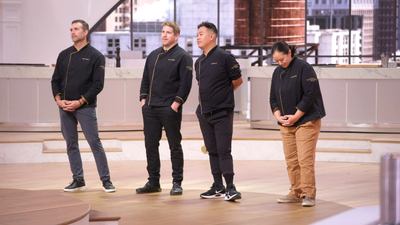
As the competition now narrows to its final four—Chris Morgan, Buddha Lo, Matt Peters, and Cara Stadler—the tension continues to build. With the finale set to air on May 13, one chef will walk away with the $1 million prize, marking a historic moment for the genre.
If Season 1 has proven anything, it’s that no frontrunner is ever truly safe. And if even Padma Lakshmi can’t predict what will happen next, viewers should expect the unexpected all the way to the finish line.