The episode 6 of Top Chef Season 23 delivered a shocking twist that immediately raised the stakes: for the first time this season, there was no Quickfire Challenge. Instead of a warm-up round, the remaining 10 contestants were thrown straight into one of the most physically and mentally demanding tasks yet — a nearly 24-hour whole hog barbecue challenge.

No Quickfire — Straight Into the Fire
In a format that usually relies on Quickfire challenges to test creativity and grant advantages, this episode completely flipped expectations. By eliminating the Quickfire, the show stripped away any buffer or second chances. There were no immunity boosts, no early wins, and no room to ease into the competition. From the very beginning, the chefs were under pressure — and it didn’t let up.
Set in the Piedmont region of North Carolina, the challenge focused entirely on Carolina-style barbecue, a tradition deeply rooted in time, patience, and precision. The absence of a Quickfire meant that everything hinged on this single, high-stakes Elimination Challenge.
A 24-Hour Test of Endurance
The chefs were tasked with smoking a whole hog — a process that typically takes 10 to 12 hours — and transforming it into five distinct dishes using different cuts: shoulder, loin, belly, ham, and chopped meat. With no Quickfire to offset mistakes, every decision carried weight.
Guest judge Sam Jones, a fourth-generation barbecue expert, emphasized the importance of tradition, particularly the differences between Eastern (vinegar-based) and Western (sweeter, thicker) Carolina styles. The chefs had to honor these roots while still showcasing innovation — all under extreme time pressure.
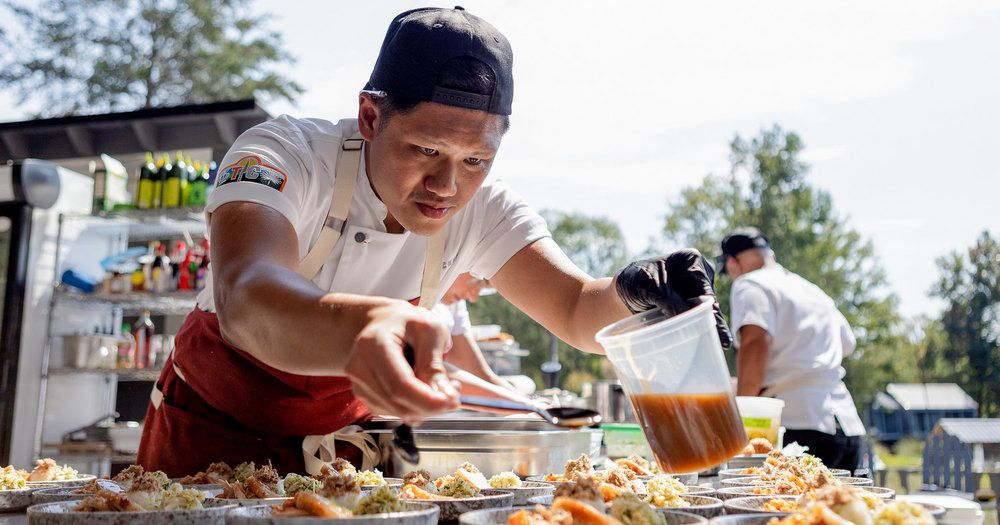
Team Battle With No Safety Net
The contestants were split into two teams led by Anthony Jones and Justin Tootla. Each chef went head-to-head against a rival using the same cut of pork, competing for both individual cash prizes and overall team victory.
But without a Quickfire advantage, there was no cushion for failure. One bad dish could send a chef home — no prior immunity, no second chances.
Team Anthony quickly took control of the competition, winning the first three rounds and securing overall victory and immunity. That left Team Justin fully exposed at Judges’ Table.
High Risk, High Consequences
The lack of a Quickfire didn’t just increase pressure — it changed strategy entirely. Teams had to think long-term from the very start, managing time, heat, and technique over an extended period.
One critical moment came during the loin round: Team Anthony chose to remove their hog early to protect the delicate cut, while Sieger Bayer from the opposing team left his hog in the smoker for hours without checking. In a challenge where there was no earlier win to fall back on, that decision proved costly.
Even a surprise visit from head judge Tom Colicchio, who introduced a bonus “s’mores-off” for extra cash, did little to ease the tension. The main challenge still determined everything.
Elimination Without a Safety Net
At Judges’ Table, the consequences of skipping the Quickfire became fully clear. Only those who won their individual matchups were safe. The rest of Team Justin faced elimination, with no prior performance to protect them.
In the end, Sieger Bayer was sent home — a stark reminder that in this episode, there was nowhere to hide.
:max_bytes(150000):strip_icc()/Top-Chef-Contestants-Season-23-FT-DGTL0126-Sieger-Bayer-3556f70833784fb3a42c59622c548e5c.jpg)
Meanwhile, Laurence Louie emerged as the standout performer, winning the challenge and earning immunity for the next round.

A Turning Point for the Season
By removing the Quickfire, Top Chef fundamentally changed the rhythm of the competition. The episode became less about quick creativity and more about endurance, discipline, and flawless execution over time.
It was a bold move — and one that made this episode feel more intense, more unforgiving, and far more revealing of each chef’s true capabilities.
As the competition continues, one thing is certain: if this episode proved anything, it’s that without a Quickfire safety net, every single moment in the kitchen can make — or break — a chef’s journey.