More than 25 years after its debut, many fans still consider Good Eats one of the greatest cooking shows ever produced. While Food Network’s schedule today is packed with competition series and familiar reruns, Good Eats continues to stand out thanks to its unique blend of science, education, and comedy.
Alton Brown Changed Cooking Television
Before becoming one of Food Network’s biggest stars, Alton Brown worked as a cinematographer in Georgia, even filming the music video for R.E.M.‘s hit song “The One I Love.”
After attending culinary school, Brown developed a cooking show inspired by three unlikely influences:
- Julia Child‘s approachable teaching style.
- Don Herbert‘s science education.
- Monty Python‘s surreal humor.
The pilot eventually caught Food Network’s attention, leading to Good Eats, which premiered in 1999.
More Than Recipes—It Explained Why
What truly separated Good Eats from traditional cooking shows was Brown’s obsession with explaining the science behind every recipe.
Rather than simply telling viewers what to do, he broke down concepts including:
- The Maillard reaction behind browning meat.
- Why eggs poach differently depending on temperature.
- How ingredients like gelatin behave chemically.
- The physics behind baking, roasting, and grilling.
Brown often compared cooking to fixing a machine—an approach inspired by his mechanic grandfather—and encouraged viewers to understand the mechanics of food instead of memorizing recipes.
That educational style helped inspire a new generation of food educators, including creators associated with America’s Test Kitchen, J. Kenji López-Alt, and Andrew Rea.
A Cooking Show Unlike Any Other

Brown’s filmmaking background also gave Good Eats a visual style unlike anything else on television.
Instead of relying on static kitchen cameras, the series featured:
- Dutch-angle camera shots.
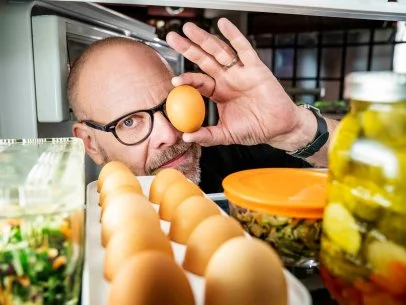
- Cameras placed inside ovens, refrigerators, and cabinets.
- Fast-paced editing.
- Pop culture references throughout every episode.
The show frequently turned cooking lessons into elaborate comedy sketches.
Whether defending butter in a fictional courtroom or parodying films like Cast Away, every joke still served the episode’s educational purpose.
Why Fans Still Return To It
While modern Food Network programming is dominated by competition shows such as Chopped, Beat Bobby Flay, and countless appearances from Guy Fieri, Good Eats remains refreshingly different.
Instead of focusing on elimination rounds or dramatic judging, it celebrates curiosity, creativity, and understanding the science behind everyday cooking.
That combination of humor, filmmaking, and practical education is why many longtime viewers still consider Good Eats Food Network’s most timeless series—and why every unexpected rerun feels like a welcome surprise.