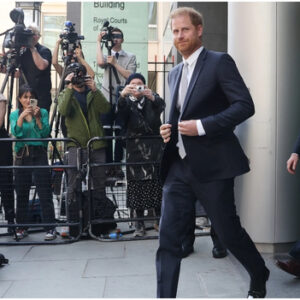
Prince Harry’s legal battle against the publisher of the Daily Mail may already have ended in defeat, but the Duke of Sussex is now fighting a different battle—one that could determine whether he and his fellow claimants must shoulder one of the largest legal bills in recent British media history.
Following the High Court’s decision to dismiss every allegation that Associated Newspapers had engaged in unlawful information gathering, the newspaper’s publisher is now asking the court to order Prince Harry and the six other unsuccessful claimants to pay costs on an indemnity basis rather than the standard basis.

If the request succeeds, the financial consequences could be enormous.
Associated Newspapers says it has spent approximately £34 million defending the four-year legal action and argues that the claimants’ conduct throughout the proceedings was so exceptional that they should bear the vast majority of those costs.
However, Harry’s legal team insists there is no justification for such an order.

Instead of arguing that the claimants should pay nothing, the Duke’s lawyers are asking the court to reject the publisher’s attempt to recover costs at the higher indemnity level.
Their position is that the lawsuit was brought honestly, pursued responsibly and should be treated like any other unsuccessful civil claim.
Representing Prince Harry and the six other claimants, barrister David Sherborne argued that they launched the case “in good faith” after years of intrusive media coverage.
He told the court:
“They have approached this litigation in good faith, under the burden of decades of intense, intrusive media scrutiny into their private lives.”
According to Sherborne, losing the case does not mean the claimants acted improperly.
Associated Newspapers has repeatedly argued that many allegations were speculative and unsupported by evidence, but Harry’s legal team firmly disagrees.
In written submissions, the claimants insisted their allegations against the publisher:
“were neither speculative nor weak.”
The publisher had accused the group of constantly changing its claims during the lengthy proceedings, describing the litigation as “highly unreasonable and inexcusable” and arguing that enormous amounts of time and money were wasted responding to allegations that were later abandoned.

Harry’s lawyers, however, argued that adjustments during such a complex trial were entirely normal.
Sherborne said:
“It was reasonable to expect that there will be evolution”
in the way the claimants’ case developed throughout the litigation.
That argument strikes at the heart of Associated Newspapers’ request for indemnity costs.
The publisher says the claimants’ conduct was so far outside ordinary legal practice that the court should require them to pay substantially more than would normally be awarded after losing a civil lawsuit.
Harry’s legal team argues exactly the opposite.
They say this case should be treated under the usual costs rules because there was nothing dishonest or abusive about the way it was pursued.
Another major point of disagreement concerns the size of the legal bill itself.
Associated Newspapers says its costs have reached roughly £34 million after defending the claims over four years.
Sherborne described that figure as:
“astonishingly high,”
arguing that the publisher deliberately chose an extremely expensive litigation strategy.
He accused Associated of adopting:
“a ‘no expense spared’ approach to this litigation and such costs should not be condoned by the court from an inter partes perspective.”
In other words, Harry’s legal team argues that the newspaper should not automatically recover every pound simply because it decided to spend heavily defending itself.
The financial implications could be significant for all seven claimants.
The court heard that they collectively obtained insurance covering approximately £16.2 million in legal costs.
That insurance, however, is considerably lower than the amount Associated Newspapers says it has spent.
If the court grants indemnity costs, the claimants could become personally responsible for paying whatever remains beyond the insurance cover.
Sherborne warned that such an outcome would have severe consequences.
He said:
“It would have a particularly harsh impact on the seven individual claimants in these proceedings, who will bear personal liability for Associated’s costs in excess of their [insurance] cover.”
Importantly, that potential liability would not fall solely on Prince Harry.
The responsibility would be shared among all seven unsuccessful claimants, including Baroness Doreen Lawrence, Sir Elton John, David Furnish, Elizabeth Hurley, Sadie Frost and Sir Simon Hughes.
Exactly how any future payment would be divided has not yet been determined.
For now, no one has been ordered to pay the £34 million claimed by Associated Newspapers.
The High Court is currently deciding whether the claimants should pay costs on the ordinary standard basis or on the far more expensive indemnity basis requested by the publisher.
That distinction could ultimately determine how much money Prince Harry and the other claimants are required to contribute.
Mr Justice Nicklin is expected to deliver his ruling on costs at a later date.
Until then, Prince Harry’s latest legal fight is no longer about proving whether unlawful information gathering occurred.
Instead, it has become a battle over whether the court should spare him and his fellow claimants from paying the full financial price of one of Britain’s most closely watched media lawsuits.