Prince Harry and Meghan Markle’s reported return to Britain can easily be presented as a family story: a son moving closer to a father undergoing cancer treatment, grandchildren returning to their grandfather’s country, and two children beginning a British education. But viewed from the perspective of the future King, the move creates a much more difficult question.
The immediate issue is not whether Harry can come home. It is what his permanent presence in Britain could eventually require Prince William to do.
According to Robert Jobson’s article in the Daily Mail, Harry and Meghan are expected to leave California before the end of August and establish themselves in a private residence outside London, possibly in the Cotswolds. Archie, seven, and Lilibet, five, are due to start at a British school in September, while the Sussexes intend to retain both their Montecito mansion and their property in Portugal.
Officially, the boundaries appear clear. Harry and Meghan remain private individuals. They are not returning as working royals and will not resume royal duties.
Yet geography changes the equation.
For six years, the Atlantic Ocean created a useful physical boundary between the Sussexes and the working monarchy. William and Catherine could perform engagements in Britain while Harry and Meghan pursued their own commercial and charitable interests thousands of miles away.
Once both families are operating in the same country, that distinction becomes harder to communicate.
Jobson reduces the danger to a memorable phrase: “two courts in one country. One serving, one selling.”
Harry’s activities will inevitably attract attention partly because he is the King’s son and William’s brother. No formal agreement can completely separate his commercial value from his royal identity.
That may become particularly important because the return appears far less spontaneous than its timing suggests.
King Charles was reportedly informed only on Sunday. Yet Archie and Lilibet are already preparing to enter British education. As Jobson observes, “No family enrolls two children in British schools in a fortnight.”
Schools require applications, communication with administrators and considerable preparation. If the children are ready to begin classes in September, groundwork must have been taking place before Charles received formal notice.
:max_bytes(150000):strip_icc():focal(749x0:751x2)/commonwealth-day-26-481ca01a00544f028e85cb0254ce48cb.jpg)
That makes the Sussexes’ July visit to Highgrove particularly intriguing. Charles saw Archie and Lilibet there for the first time since 2022. Reports say the impending relocation was not discussed. Jobson finds that difficult to reconcile with the apparent level of preparation already underway.
It also represents a remarkable reversal for Harry.
On May 2 last year, after losing his appeal concerning police protection, he told the BBC that he could not “see a world” in which he would bring his wife and children back to Britain. Fifteen months later, the children are preparing to attend school there.
Security therefore remains an unavoidable complication.
Harry is fifth in line to the throne, Archie sixth and Lilibet seventh. Jobson argues that three people so close to the Crown cannot realistically live in Britain without appropriate protection. He even suggests that a narrowly defined working role could provide one route through the security problem.
That is Jobson’s argument rather than an announced Palace proposal, but it demonstrates the contradiction created by the move: the Sussexes can remain officially outside the working monarchy while their physical presence keeps generating questions normally associated with people inside it.
Archie’s situation illustrates this particularly well.
Until now, he has largely been an American-raised child with a British royal title. Beginning in September, he could instead be growing up among British classmates while living relatively close to the institution in whose succession he occupies sixth place.
As Jobson puts it, “Monarchy runs on familiarity.”
Yet the most politically delicate consequences may not concern Archie at all. They concern William and Catherine.
Charles can welcome Harry as a father. He can enjoy Archie and Lilibet as a grandfather. William does not have precisely the same luxury because he will eventually inherit responsibility for the institution surrounding all of them.
Any accommodation established during Charles’s reign could therefore become part of William’s future landscape.
Christmas may provide an early demonstration.
Imagine Harry living permanently in England, with Archie and Lilibet attending British schools. Does the family invite them to the traditional Christmas walk to St Mary Magdalene?
Excluding Harry risks making the Royal Family appear unforgiving. Including him could produce photographs suggesting that years of accusations and estrangement have somehow been erased.
That dilemma becomes more serious because of something Catherine reportedly said after one of the most memorable public reunions of the Sussex and Wales couples.
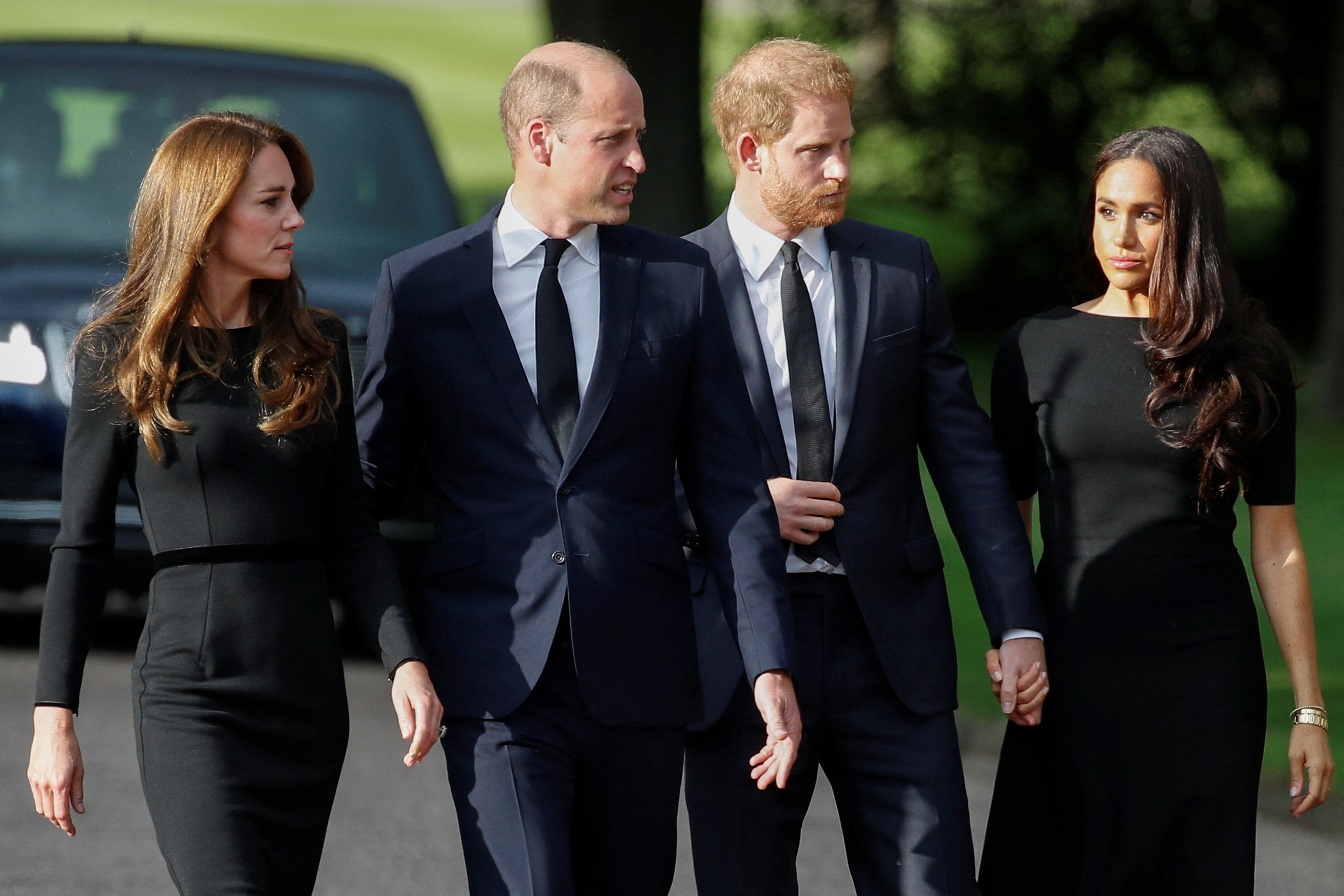
On September 10, 2022, four days after Queen Elizabeth II died, William, Catherine, Harry and Meghan walked together outside Windsor Castle before crowds and cameras.
Afterwards, Jobson says Catherine told a close source that it had been “the hardest thing I’ve ever had to do.”
That statement changes the emotional mathematics of another carefully choreographed reunion.
Harry’s criticism was not confined to abstract disagreements about monarchy. In Spare, he attacked Camilla and wrote that she had “sacrificed” him “on her personal PR altar.” His relationship with William also remains unresolved.
For Jobson, reconciliation therefore requires something more substantial than geographical proximity. He believes Harry should publicly apologise to his father, brother and the British public, while the Palace should reaffirm that the 2020 settlement remains intact.
Whether Harry would ever make such an apology is another matter.
There has also been speculation that the resignation of Charles’s principal private secretary, Sir Clive Alderton — identified as “the Wasp” in Spare — could make Harry’s return easier. Jobson raises the possibility but does not establish it as fact. Likewise, he rejects speculation that the Sussexes’ return proves Charles’s cancer is significantly worse than publicly understood: the King remains in treatment and continues working.
Ultimately, this may be why Harry’s return matters more to William than to Charles.
Charles is being given another opportunity to have his younger son and grandchildren nearby. William may eventually inherit everything that comes with that arrangement.
And the Palace can define titles, duties and protocols far more easily than it can repair trust.
As Jobson puts it: “Rebuilding takes two people who want it rebuilt. I see one.”